| 6 comments ]

Or the elbow. Or the 'chop'. Or that crazy signal that means traveling in basketball. What the heck are those zebras on about anyway?

Well, if you can crack the code to their mysterious sign language, you'll gain access to a whole new world of secret information. Okay, not really, but it will keep you from annoying the Striped Ones with silly questions, give you more knowledge as a captain or alternate to communicate intelligently with the refs and be a better advocate for your team, and give you the ability to tell/ask your teammates why they went to the box while they're still in the box. All cool stuff.

Here are some of the most common signals you'll want to know:


Lead Jammer
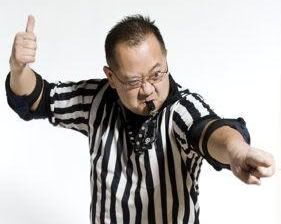
What every point-scoring star wants to see. My favorite refs are the ones who do this signal with great flourish, making the event fancier for everyone. Showmanship, people... showmanship.


Not Lead Jammer/No Lead Jammer

Opposite of awesome. Also known as "You phail and must skate the full two minutes!"


Elbowing
For shame! If you're new, you probably see this one a lot. Keep those chicken wings in check and focus on laying the smack down legally. Or for pete's sake, if you're going to elbow, at least use the outside one!

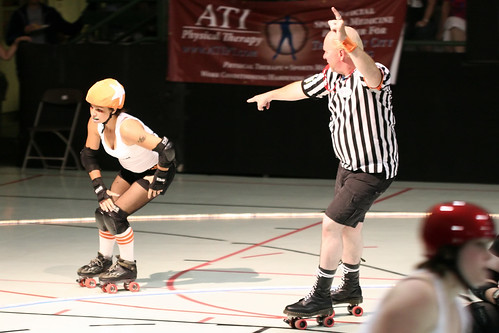
Edit: The WFTDA-approved and more common signal for this penalty has the ref touching or cupping their elbow with the opposite hand, as seen here. Either way, you know you've been bad!


Out of Play/20 feet

Watch out pivots! That cocked arm is your warning. If you get the tomahawk chop, you've just been penalized. When the arm comes up, it's a good time for the rest of the pack to tell you to lay off.


Back Blocking

Getting a little too close and personal with the other team? You'll see this one if you've been all but spooning the opposing skaters. The signal used looks like a push, although technically pushing with the hands and back blocking are different penalties, and pushing actually falls under the next category.


Illegal Use of Forearms/Hands

You'll see this signal if you've been pushing, groping, grabbing or whipping off of the opposing team. Although pushing actually falls under this category, refs will usually use the back blocking signal for a push and this signal for holding. See how tricky they are?


Cutting the Track

See those crossed bones? That's poison to jammers, to be avoided if at all possible.


Tripping/Low Block

Whether you meant it or not, taking out other ladies' skates with your skates is a no-no.


Special Bonus Section!

  • When a ref sends you to the sin bin with one pointed finger, you just fouled out on a major.
  • When they send you out with four fingers and the thumb tucked in, you just fouled out on four minors.
  • When you're jamming, and you hear your jammer ref tapping the top of their helmet with their wristguard, it means you're about to get slammed by the other jammer.
  • Too many skaters on the track, false starting, illegal star passes, calling off the jam when not lead jammer and cutting in front of skaters when leaving the penalty box all fall under illegal procedure. Many refs will also use this one when a skater does not have their mouthguard in, although the rules do not specify the penalty for removing your mouthguard and leave it to the refs' discretion, it seems to be the widely accepted signal.
  • One of my favorite signals is the one for gross misconduct, with one hand on the hip as if to say "Oh no, you didn't!"
Check out these other resources for a complete and comical listing of WFTDA referee hand signals

WFTDA Offciating Hand Signals
Rat City Rollergirls Referee Hand Signals

Photos by Rat City Rollergirls and ohtoberich
--> Read more...

| Comments ]

You know you have to do it, but just thinking about it makes you break out in a cold sweat. You've got flashbacks to stuffy classrooms where every pencil seems to be scratching along but yours. Imagining all those multiple choice questions and diagrams on paper in front of you makes all the rules you think know fly right out of your head and it 'aint pretty.

Relax. Every rollergirl that skates for a WFTDA or WFTDA-aspiring league has done it and so can you. Maybe you're taking the test for the first time as the last hurdle before getting placed on a team. Or maybe your league gives the test every season and you need to brush up on any revisions. You can give yourself a much greater chance for success if you have a plan in place and use the right strategies.

First, review what you already know

You're probably more knowledgeable than you think. For example, do you know how many whistles signal the end of a jam? How long a skater goes to the box for a major penalty? Who can call a time out? What the helmet covers mean?

Information that may seem like a no-brainer because you've already learned it by experience will still be on the written test. All those rules you've learned by doing will be one less thing to worry about on test day.

Identify the things you most need to learn

If you get called in scrimmages for penalties you don't understand, that 's a sign that you have an opportunity to learn! Talk to the refs after practice and ask them to explain the penalty to you. They're usually happy to share their knowledge, especially if you take a genuine interest in understanding the rules.

Watch some WFTDA bouts on YouTube or RollerSport.TV and pay attention to the flow of the game. Look for things that don't make sense to you. Do you understand why they're stopping the period clock, why the jammer got 4 points for a pass when only 3 blockers were on the track, or why the captain is serving a penalty when she didn't skate the last jam?

Take notes and then ask your captain, senior skaters or referees about the situation. Download a pdf of the rules and use the search function to find the answers to your questions. Pretend another skater has asked you a question and you have to research the answer for her.

The things you'll probably need to brush up on most are the rules that have to do with referee protocol and support staff, so pay special attention to those areas. Highlight or write the numbers of the rule sections that make the least sense to you.

Read the rules

First, make sure you have a copy of the rules. Paper is great, if you learn better by reading something you can hold, but otherwise I recommend having a pdf version. You can use the search function to skim through a pdf and find the section you are looking for right away whenever you want to study a specific rule.

Then, read the rules. All of them. I know this sounds tedious, which it is if you're not the sort of person who thinks reading contracts and legal documents is fun, but the best way to learn the rules is straight from the source. Think of it as your textbook for the written test.

Asking questions from others in your league is great, and encouraged, but always read the pertinent section of the rules afterward. Not only will it clear up any possible inconsistencies, it will help cement the rules in your mind by reviewing them.

You can read the rules in one sitting, if that idea appeals to you, or break it up into chunks. Decide to read one or two sections each day, or read for 30 minutes and then stop. Just make sure you get through the entire document at least once before you start studying. If you're surprised by a question on the test you didn't specifically study for, the wording of it will likely jog that bit of the rules out of your memory if you've read the whole thing.

Having read the complete rules will also make you a better player or captain, so don't skip this step!

Create your study strategy

To be as prepared as you possibly can be for the test, you have to have a plan of attack for learning the information. So how do make this battle plan? Think of it like a bout. Exploit your strengths, address your weaknesses and build your confidence before tackling the test.

These general study strategies will apply to everyone:
  • If you study in a group, only study with others who are serious about passing the test.
  • Study at times when you naturally have the most mental energy. If you're a morning person, check out a few flash cards on the way to work. If you're more alert at night, read a section of two after dinner.
  • Review the rules and your notes right after practice, or after skating, while the associated actions are still fresh in your memory.
  • Don't try to cram. Space out your study times over the course of the week and focus on one area at a time.
  • Learn the general concepts first; don't worry about learning the details until you have learned the main ideas.
  • Take notes. Jot down a summary of the rule sections as you read them.
  • Take frequent breaks to avoid overload. Tell yourself you will study one section, or study for 20 minutes and then take a 5 minute break. Don't skip your breaks!
  • Make sure that you understand the rules. Don't just try to memorize everything. Get clarification from others and use strategies specific to your learning style to really cement an understanding of the rules in your mind.
  • Have a fellow skater, friend, or family member quiz you on difficult areas.
Use your strengths by studying they way you learn best

You can also take advantage of your particular learning style to help you absorb information quickly. Here's an overview of some specific strategies.

Are you a visual learner? Do things "make sense when you see them"? Try some of these strategies to help you study:
  • Look for visual sources of information. Use videos or Power Point presentations to help you learn.
  • Make yourself some flash cards.
  • Use highlighters and take notes or draw diagrams in the margins of your notes or the rules.
  • Draw mind maps or concept maps to help you review and learn each section.
  • Focus on the "big picture". Look through section titles, bullet points, pictures and diagrams to get an overall idea of the content before reading a section.
  • Visualize. As you learn a new concept, close your eyes and imagine it playing out in a bout situation.
  • Avoid visual distractions while you study.
Are you an auditory learner? Does it help to hear the information you're studying?
  • Read key sections of the rules aloud
  • Discuss the rules with other league members. "Talk through" a situation where the rules might apply.
  • Explain the rules to another skater or a study partner.
  • As you read, imagine yourself giving a lecture on the subject.
  • Make up rhymes, songs or mnemonics to help you recall the rules. The crazier the better.
  • Write out important concepts in sentence form, then read them aloud.
  • Summarize a rule section in your own words and record yourself reading it. Play it back in the car or when you're doing simple tasks like cleaning.
  • Avoid noisy distractions while studying.
Are you a person who learns by doing? Does sitting still and studying make you ansty? Try these study methods:
  • Simplify the information into the basic elements and build up from there.
  • Act out concepts, such as penalties, to help you remember. Use a partner for this if you like.
  • Ask your league mates for real life examples of how the rules apply, or for a demonstration if you don't understand.
  • Connect the rules to things you actually do in practice and scrimmages. As you study, remember the last time you were involved in the situation the rule describes. Move around if it helps.
  • Draw a chart with some X's and O's, or use board game pieces to simulate things like pack formation, out of play, legal passing etc.
  • Write out notes by hand. Describe a situation in which the rule section you are studying applied to you in your notes. Make it a story.
  • If chewing gum, fidgeting, or pacing the room helps you relax as you study, go for it.
  • If you get too restless, look over some notes or flash cards as you go for a walk.
Address your weaknesses

Spend the most time on the sections you find hardest to remember or understand using the techniques that have worked best for you.

Before you study one of these difficult sections, briefly review a section you understand well to boost your confidence and settle your mind into a calm learning mode.

Taking a dummy test, or having a friend quiz you can help you pinpoint the sections you need to work on most. Revisit those sections with another quiz or dummy test to evaluate your progress.

Stay positive and confident

The night before the test, do a short, relaxed review of all your notes and remind yourself that you are well prepared and are going to do well. Resist the urge to cram!

Visualize yourself taking the test and answering all the questions confidently without any nervousness. Do this several times before you go to sleep and again just before taking the test. Get a good night's sleep and keep a positive attitude.

Test day

You'll probably be taking the test in the evening, around the time you usually practice, so make sure you're not too burned out from the day's activities. Plan some calming, pleasant things to do for a couple hours before the test like listening to music, light physical activity or whatever makes you feel alert and relaxed. If you're one of those morning people who starts to fade after work, take a short nap if you can.

Eat a light snack such as some fresh fruits and veggies before the test, but avoid greasy or sugary foods or caffeine, as they can negatively affect your focus and concentration.

Arrive early with pencils, scratch paper (if it's allowed), or anything else you need to take the test. Remind yourself that you're going to do well and imagine yourself answering all the questions to the best of your ability.

Resist the urge to talk to other skaters about the test or how you think you will do. Anxiety is contagious.

Taking the actual test

Approaching the test in a relaxed, confident way, and using some simple techniques for managing your time can help you score much higher on your WFTDA rules test.
  • Stay positive and relaxed. If you start to feel nervous, take a few deep breaths and remind yourself that you are well prepared and are going to do your best.
  • Get comfortable. Change positions throughout the test if you need to.
  • Make sure to read all the directions carefully. It seems obvious, but it can help you avoid silly mistakes.
  • Read each question carefully. Don't just skim it and assume you know what the answer is.
  • If you have time, quickly look through the entire test for an overview. This will help you budget your time. If it's allowed, briefly jot down any notes that come to mind so you can refer to them later.
  • Bring a watch so you can pace yourself.
  • Write legibly. If the graders can't read it, they will probably mark it wrong.
  • If you don't understand a question or need clarification, ask the coach or whoever is administering the test. Don't just guess.
  • If you go blank on a question, skip it and go on. You can always come back to it later, and another part of the test may jog your memory or help you out with one of the tougher questions.
  • Answer the questions that are easiest for you first, then answer the questions with the highest point value. Finally, come back to the more difficult questions or the ones you skipped.
  • When going back to the questions you skipped, eliminate the answers that you know are wrong, don't seem to fit, or are so similar they would both be incorrect. Then, make your most educated guess based on what's left. If it's an essay question, broadly outline your answer, sequence your main points, and do your best. Don't try to b.s.
  • Don't worry if other girls finish before you. Just focus on your own test.
  • When you finish, review your test for any careless mistakes, and proof read your essay answers, if any. Only change an answer if you misread the question, or if you find information elsewhere in the test that indicates your first answer was wrong. Make sure your name is on the test!
All done!

Once you turn in your test, take a deep breath and pat yourself on the back for a job well done. If you have to re-take the test, don't sweat it! You'll be even more prepared for a re-take because you can review your study techniques and pinpoint what worked and what didn't.

Most of all, remember you are doing this so that you can do something fun: play roller derby!

I hope this article helped you prepare for your WFTDA written test! Good luck!

Comments? Test-taking tip you want to share? Leave them below!
--> Read more...

| Comments ]

Tying my skates isn't something I think about after I've done it. But I find that after warming up I usually have to re-tie them because they've loosened. Jamming and certain drills seem to make my laces slip too, and I hate going into a corner and thinking about how I need to tie my skates as soon as I get off the track.

My old double knot just wasn't cutting the mustard. Maybe I needed a better way to tie my skates?

So I found this super-secure knot from Ian's Shoelace Site. Seriously, it's a whole site about just shoelaces, and it's not even remotely a joke. And people think being obsessed with roller derby is weird...

Ian's secure knot is just the thing for keeping your skates tied, though. I used this knot at my last practice where we happened to be doing a lot of hopping, manuals, and one-legged agility work. My skates were just as tight at the end of the night as they were when I first tied them, yet the knot was easy to undo. I'll definitely be tying my skates this way from here on out.

The knot is simple to learn, thanks to some nice diagrams, and easy to remember and show to others. I taught it to another girl the same night and she also had great results with it keeping her skates snug.

Check out the instructions for Ian's secure knot here. While you're at it, take a look at this article that explains what makes your laces keep coming undone.

You may have been tying your skates the wrong way all along.
--> Read more...

| Comments ]


Inquiring minds want to know. From your travel team pivot to that guy sitting in the crash zone and waving an eye chart he made out of posterboard at your head ref, skaters and spectators often wonder: What do refs really see?

Check out this referee helmet cam video from the Charm City vs. Windy City Eastern Regionals bout and find out what the action looks like from inside the vertical stripes.

This particular ref is skating around the outside of the track, but there are a few seconds of footage from the infield as well at around the 1:25 mark. Which is fairly hilarious, because the ref actually crosses the track to the center just to tell a skater to get the eff out. Watch his frantic "Authoritative Point Which Singles Out The Naughty"!

While you're watching, try this fun interactive activity!
  • Turn on your TV to a sporting event and crank the volume as loud as it will go.
  • Put your skates and all your gear on.
  • Stick a whistle in your mouth.
  • Have a friend or small child fall down near you at random intervals.
  • If you can find a few buddies to yell profanities at you, even better.
  • Now, see how many penalties you can catch!


There's a bitchin' soundtrack but no audio, 'cause us mere mortals aren't supposed to hear secret zebra-speak. It makes your bearings rust and your teeth fall out, trust me.

The best part is, I really had no idea how completely freaking awesome the derby action looks from the ref's point of view. They've got the best seats in the house, that's for sure.

http://madrollindolls.com/footage.htm
http://HinckleyProductions.com
--> Read more...

| Comments ]

It's one of the first drills many of us participate in, yet it remains as relevant to veterans as it is to newbies. I'm talking about your basic line.

People call it different things; a pace line, a draft line, or sometimes a weave line or a snake, but in its simplest form it's a group of skaters, one behind the other, each maintaining a consistent speed and distance from one another. Now, if that's all you do, it can get stale pretty quick, but there are lot of variations on the line that can help build, speed, focus, agility, endurance, blocking effectiveness, timing, pack awareness, and team cohesiveness.

Let's look at some different ways to use the line now.

The Pace Line

This is the line in it's purest form. Each skater remains a consistent distance behind the skater in front of her and the foremost skater controls the speed of the line. The skaters in the rear must all match her stride, so that they are pushing off of their left and right feet at the same time.

It's crucial that the line leader find a consistent rhythm and stick with it so the rest of the line can fall into step. If you're doing it right, it's like marching in time on skates. It's truly amazing to see one line pumping along with every skater in sync like the wheels on a train.

Once the line has been skating in unison for a bit, the front skater drops to the back and the next skater takes the lead.

This type of line forces skaters to become more aware of their stride, and also of their teammates' strides. It encourages a methodical rhythm and focus on proper form and makes each skater pay close attention to her leader.

Keep in mind, this is difficult at first, but stick with it. By adjusting the width and power of each push, even skaters of very different heights can match up their strides.

Rat City is one league that uses this skill to great advantage. Each girl knows her teammates' strides so well that collectively controlling the speed of the pack becomes intuitive for them, and they can do it without any verbal cues.

Follow the Leader

The leader of this line can skate in any direction they choose and everyone else must follow. They can slow down, speed up, veer, cut, loop-the-loop and change directions all they want. Once they've been leading for a little while, they drop back and let the next skater take the wheel. Or, put your wiliest skater in front and your least agile skaters in the back and watch the hilarity ensue.

This type of line is great for agility and awareness, since it's critical to observe the way the line is moving ahead of you in order to stay in formation. Remember, the closer a skater is to the back of the line, the quicker they have to be.

The Weave Line

Also called the snake, this variation is a staple of many practices. The rearmost skater "weaves" her way to the front, slipping between the other skaters in line as if they were cones.

This is a great drill to build agility and a sense of timing, and it can really help new girls get comfortable with the idea of skating close to others.

Any weaving line can also be a great opportunity to work on communication. Have girls look over their shoulders and tell the skater in front of them if the weaving skater is coming on her inside or outside. Get those third blockers and pivots yelling!

There are tons of variations to the weave line. Here a few:
  • Backward Weave - The foremost skates drops backward through the line, weaving as she goes. Excellent for working on veering or cutting skills, speed control, and looking over your shoulder.
  • Monkey Bar Weave - Skaters in the line present their 'monkey bars'; arms back and slightly bent, ready for the rearmost skater to grab on and whip herself through the line.
  • Blocking Snake - As the skater moves through the line, she checks each skater she passes. You can specifying whether hip or shoulder checks are to be used, or add another layer of difficulty by having each skater crouch and touch the ground before checking, so that she executes a 'swooping' or 'J' block.
  • Weaving Walls - The two rearmost skaters must weave through the line as a 'wall' and remain connected (touching at the shoulder, hip, or knee, in order of difficulty) as they weave.
  • Crossing Weave - Skaters weave through the line, but must make lateral movements only by crossing over. Great agility drill. If you're feeling particularly evil, do it backwards.
  • Hopping Weave - Same idea as the Crossing Weave, but skaters use large lateral hops to weave through the line.
Catch the Tail

Also called the Swedish Mile. The foremost skater breaks away and sprints around the track to the back of the line. Excellent for endurance. You can also split the group into two lines and have the front skater in each line 'race' one other to the back.

Try having the rearmost skater weave to the front and race the foremost skater to the back. That skater then weaves the line and races the person now in front to the back, and so on.

Another variation is to weave through the line, and upon reaching the back and sprint around for a second lap, ending at the rear once more. This variation can also be done with two parallel lines and racing pairs.

Newbie to Veteran

Brand new skaters are usually focused only on their feet, and working with lines can be a great way to get them looking up and paying attention to what's going on around them with less confusion than being in a pack might cause.

Intermediate skaters can skate without thinking about it, but may have difficulty with consistent pacing and distance, or with timing. Lines are a great way for them to focus on those skills.

Advanced skaters have skating skills, consistency, and timing but line work can be an opportunity for them to hone their awareness, break down their skills, and focus purely on form and execution.

When working lines, keep an eye on your skaters at different skill levels and give them a little coaching or a reminder of where their focus should be.

I hope you enjoyed this post and found some lines you can try out at your next practice! If you have your own favorite line drills, or you come up with your own variations, please share them in the comments!
--> Read more...

| Comments ]


The alpha geeks over at Wired Magazine's GadgetLab needed to test out Nikon's flagship camera, the 12 megapixel D3. It's a camera designed for action photographers and photojournalists, such as photographers covering war zones.

With no war handy to create hellish lighting and blazing fact action conditions to put the D3 through it's paces, the Wired guys picked the next best thing: roller derby.

They took the Nikon D3 out to a B.ay A.rea D.erby Girls bout and got some sweet shots. Check out the video for the pics.


My favorite part:

"What do the girls look like?"


"They look like they could beat most of us up."

via Derby News Network
--> Read more...

| 2 comments ]


You know the site redesign I was promising you, the one you probably thought was purely fictitious and created to excuse my break from posting?

It's here.

After lots of hours and lots (really, lots) of trial and error, the new Fishnet Burnns is live.

So, tell me what you think.

And enjoy your new Burnns.
--> Read more...

| Comments ]


I know, I know, by now you think the recent lack of site updates means I don't love you.

Well, that's not true, but there have been a few things keeping me busy, chiefly among them a redesign for Fishnet Burnns. I wanted to keep it a surprise, but I just can't anymore. The new site layout will be easier to read and navigate and make commenting, following news and digging through archives simpler.

The other big thing I've been busy with is making plans to head to the Northwest Knockdown national tournament in Portland, OR, Nov. 14th through 17th.

I'll be covering the event for Fracture Magazine, so watch for that. And of course, expect plenty of Tweets from the event and score updates as the action unfolds.

If you're heading to nationals, make sure to say hello!
--> Read more...

| Comments ]

If the top-level derby players in the country are getting called out on cutting the track penalties like it's going out of style, is it just growing pains from adjusting to the 3.1 ruleset, or is something broken?

Gnosis from Derby News Network has an interesting answer to that question on his blog right now about cutting the track penalties from his perspective as a fan.

His main point is that 6.2.10.5 ("Cutting the track penalties are issued when any part of the returning skater's skates, body or equipment are touching the floor inside the track boundary") is too strict and creates too many penalties against skaters who really are trying their best to follow the rules.

This comes right on the heels of a maelstrom of penalties for cutting the track handed down at Eastern and Western regionals, which proved to be a game deciding factor in some of the closer bouts.

As a skater, nothing leaves a worse taste in your mouth than knowing your team could have won a bout if only your girls hadn't spent so much time in the box. I mean, warming the seats in the Sin Bin is one thing if you're out there roughing the other players up and really being a bad girl, but sitting out on technical calls really bites.

For fans, though, I wonder if it's sucking the fun out of the game in a different way. Spectators usually have a casual understanding of the rules to begin with, and it must look to most of them like some sort of penalty cakewalk where the prizes are random 1 minute rests. After all, no one likes to see their favorite jammer taking up residence in the penalty box jam after jam when they can't see that she's done anything wrong. Even if your team is enjoying the benefit of a 1-jammer jam, can it really be that entertaining to watch your jammer slam the points down on the opposing blockers when the other team has no way to score?

But more than that, is it unfair to the skaters, or is it a disservice to the fans to create a situation where the referees can remove the only point-scoring player from half of a scoring round for a rule infraction that doesn't always impact the other team negatively?

In any other sport, something like that might be called game-fixing. In roller derby, it's called the breaks.
--> Read more...

| Comments ]


The Minnesota Rollergirls put out this short series of public service announcements that just might remind you of someone in your league.

It's two and a half minutes of total hilarity for jammers, blockers and refs. Enjoy!


Whenever I see some of the Minnesota Rollergirls promotional material, like this video, I'm always impressed at what a perfect balance they've struck between being tough, gritty, sexy, funny, and family friendly all at once. Now there's a league with an awesome PR committee!
--> Read more...

| Comments ]

So you're just starting out, and you've decided that roller derby is something you could see yourself doing for a while. You're ready to make the leap and buy your first pair of skates, but there are so many different styles out there you're feeling overwhelmed. How do you choose?

Armed with a little knowledge beforehand you can make a decision that you can be happy with without breaking the bank.

There is an incredible amount of information to learn about skates, but for the purposes of this article I'll keep it to the stuff that will help you choose your first pair. Here's what you need to know.

Know Your Size

Roller skates are sold in men's sizes, so ladies will need to go one size down from their shoe size. If you wear a women's 9, try on an 8 in skates. Keep in mind that some brands and styles run differently, so while an 8 may fit you in a certain skate, you may need a 7 1/2 or 8 1/2 in another style. Don't assume that because one skate fit you, that same size will fit you in every skate.

Trying on

First off, when you get ready to buy, try on as many different skates as possible. Go to local skating rinks and sporting good stores and try out what's in stock. Tell them you're shopping for roller derby skates. If they don't know what you're talking about, tell them you want to try speed skates and jam skates.

If there's a shortage of retails shops that sell skates in your area, it may be worth your while to make a trip to the next largest town in your region to do a little skate shopping. You can also ask to try on other girls skates, but keep in mind that their skates will already be broken in and so a new pair will feel a little different. The most important thing is to get a feel for different styles and manufacturers and just to see what feels good on your feet.

If you just can't find a skate locally that is appropriate for derby, buying online may be your best option. You can buy just about any skate you want online, but you'll be buying blind, so if you go that route, make sure to compare size charts, measure your feet and find out how the sizes run compared to brands you may have tried. And be prepared to make an exchange rather than wear skates that cause you pain. Paying a restocking fee may suck, but wearing skates that don't fit can cause permanent damage to your feet.

How Much to Spend

Some people will tell you to go out and buy the best skates you can afford right off the bat. Other people will tell you that derby is so hard on skates that it's better to replace cheap skates every year than expensive ones. Everyone is different.

Unless you've got a trust fund burning a hole in your pocket, I would recommend spending at least $100 but no more than $200 on your first pair of skates and go from there. Once you have been skating longer you will have a much better idea of how you skate, what position you play, what feels good on your foot etc. and can make a better choice on a high-end pair of skates. Then those $100 skates that you started out with will make a great pair of beater outdoor skates.

Leather or Synthetic?

Leather

Many people prefer leather for it's durability and for the fact that it will break in to your foot for a somewhat personalized fit. A quality leather boot, properly cared for, can outlast almost every other component of your skate and can be a great investment. Leather also tends to be more expensive, and the higher quality leather used, the higher the cost of the skate. While it's possible to find leather skates on the cheap, keep in mind that the reason the cost is low is because low quality leather is used, so don't expect them to be as durable as quality leather skates.

As for the fit, a leather boot will usually feel firmer than a synthetic boot and while some skaters feel that it gives them more support, other skaters may find certain leather boots hard or uncomfortable.

When trying on skates, remember that leather skates will stretch and break in a bit, but it won't make up for a poor fitting skate. If your foot is swimming or you have spots that are getting pinched, try another size, style or brand until you find one that works.

Synthetic

Synthetic skates are a very cost-effective, animal-friendly alternative to leather, and can have a very comfortable fit with no break-in period. This is because vinyl doesn't stretch, so it will not mold to your feet like leather does. This also means that a synthetic skate is likely as comfortable as it is ever going to get, so make sure you're happy with the fit before you buy.

Synthetic skates usually feel 'softer' than leather skates, and many have a sneaker-like feel. You may find this to feel comfy, or just too squishy depending on your preference.

Vinyl skates are generally not as durable as leather, though, and if you skate like a mad woman, you can eat up a pair of synthetic skates in no time. Of course there are certain skaters out there that can tear up a leather skate almost as easily and your skating style and playing surface will have a big effect on the life of your skates.

Most synthetic skates are entry-level skates, so it's a bit more difficult to find a high quality pair if you want a vegan alternative. Manufacturers like Riedell, however, are beginning to make higher quality synthetic skates, such as the Divine.

Finding the Perfect Fit

Just remember that skates very a lot. A skate that someone else might love could feel terrible on your feet and vice versa. The most important thing is that the boot itself fits and is comfortable to you. You can upgrade the wheels and bearings on a cheap skate boot and it will feel like a much more expensive skate, but a pricey skate that fits you poorly will be money wasted. Remember that if down the road you buy a higher quality skate, you can move a lot of parts from your old skates over to the new boot, so those parts a like an investment.

Additional Resources

The best resource is often your team mates because they skate in the exact same conditions and on the same surfaces that you do every day! Don't be afraid to ask them what they like, what they don't, and what they would get if they were buying their first pair of skates over again!

Here are some web links you can check out for more information as well:

Sin City Skates Blog: New Skates - Choosing them, Breaking Them In, ETC.
Sin City Skates Blog: Vinyl vs. Leather - What Makes a Better Roller Derby Boot?
Sin City Skates Skate sizing info
Yahoo! Rollergirls group (an excellent place to ask for a rollergirls' opinion on anything derby)

To check out the skates in stock in the Fishnet Burnns Skate Shop, click here.
--> Read more...

| Comments ]


Every roller derby skater needs to have a variety of stops in her repertoire so she respond quickly to any situation. Being able to efficiently control your speed and momentum not only makes you a better blocker, jammer, or pivot, but it can often mean the difference between sustaining an injury and simply skating away.

In this awesome tutorial video, Bonnie D.Stroir of the San Diego Derby Dolls demonstrates how to stop quickly with the powerslide on both flat and banked tracks. If you've already mastered the t-stop, the mohawk stop and the snowplow, try learning this one. Keep in mind that this will be easier to learn if you can already sidesurf for a short distance.

--> Read more...

| 2 comments ]

Foot pain, blisters, bunions...all are a fact of life for most rollergirls.

Dr. Jenny Sanders shows us on her shoe blog that it doesn't have to be that way. After being consulted by a Bay Area Derby girl about her painful, swollen feet, Dr. Sanders posted this awesome blog showcasing 3 simple ways that re-lacing your skates can save you from a lot of foot discomfort.

Read the full article here.


Discovered via Roller Derby Disorder
--> Read more...